

The doctrines of Brotherhood of the Cross and Star (BCS) are fully aligned with the teachings of our Lord Jesus Christ, making it a Spiritual School of Practical Christianity (Isaiah 2:2-4, John 16:12-15, 1 Corinthians 13:10 & 12). The motto is “Faith, Hope, and Love” (1 Corinthians 13:13). Its aims are to completely love and submit to God while loving one another (Matthew 22:37-40), to follow practically in the footsteps of our Lord Jesus Christ (John 13:15, 14:15), and to spread His gospel of love to the entire world (John 20:21). Baptism, seen as the gateway to salvation and entrance into God’s Kingdom, involves repentance and receiving the Holy Spirit, which bestows spiritual gifts. It is open to all ages, can be done any time, and is based on passages such as Matthew 3:11, 28:19, John 3:5, Mark 16:16, and Ephesians 4:4-5.
BCS uses “Peace of the Father,” “Perfect Peace,” or “Peace be unto you” as universal greetings, reflecting the heavenly language of peace. This mirrors the example of Christ, the Prince of Peace (Isaiah 9:6), who greeted His disciples with peace both before and after His resurrection (John 20:19, 26) and instructed them to do the same in evangelism (Matthew 10:12-13). All members, regardless of gender, age, or status, are addressed simply as “brother” or “sister” in recognition of the shared parentage of Adam and Eve and one Creator (Genesis 1:26-27), with scriptural backing from Matthew 23:8, Acts 9:17, Revelation 6:11, and Malachi 2:10.
BCS members give thanks to God for everything they encounter (Ephesians 5:4, 20) and believe that all things work together for good for those who love Him, eliminating concepts of disappointment or failure. Common phrases include “Thank You Father,” “All is Well,” “The Father is Before and Behind,” “Listen to the Holy Spirit,” “Let the Holy Spirit Direct,” “Let the Will of God Be Done,” and “Father or Papa Bless You” (Matthew 19:34). Others are “Father Owns Everything,” “Father Knows Everything,” and “Transfer Instead of Death.” Testimonies, revelations, visions, dreams, discussions, and announcements begin and end with: “In the name of our Lord Jesus Christ. Amen. In the blood of our Lord Jesus Christ. Amen. Now and forevermore. Amen.” (Ephesians 5:20).
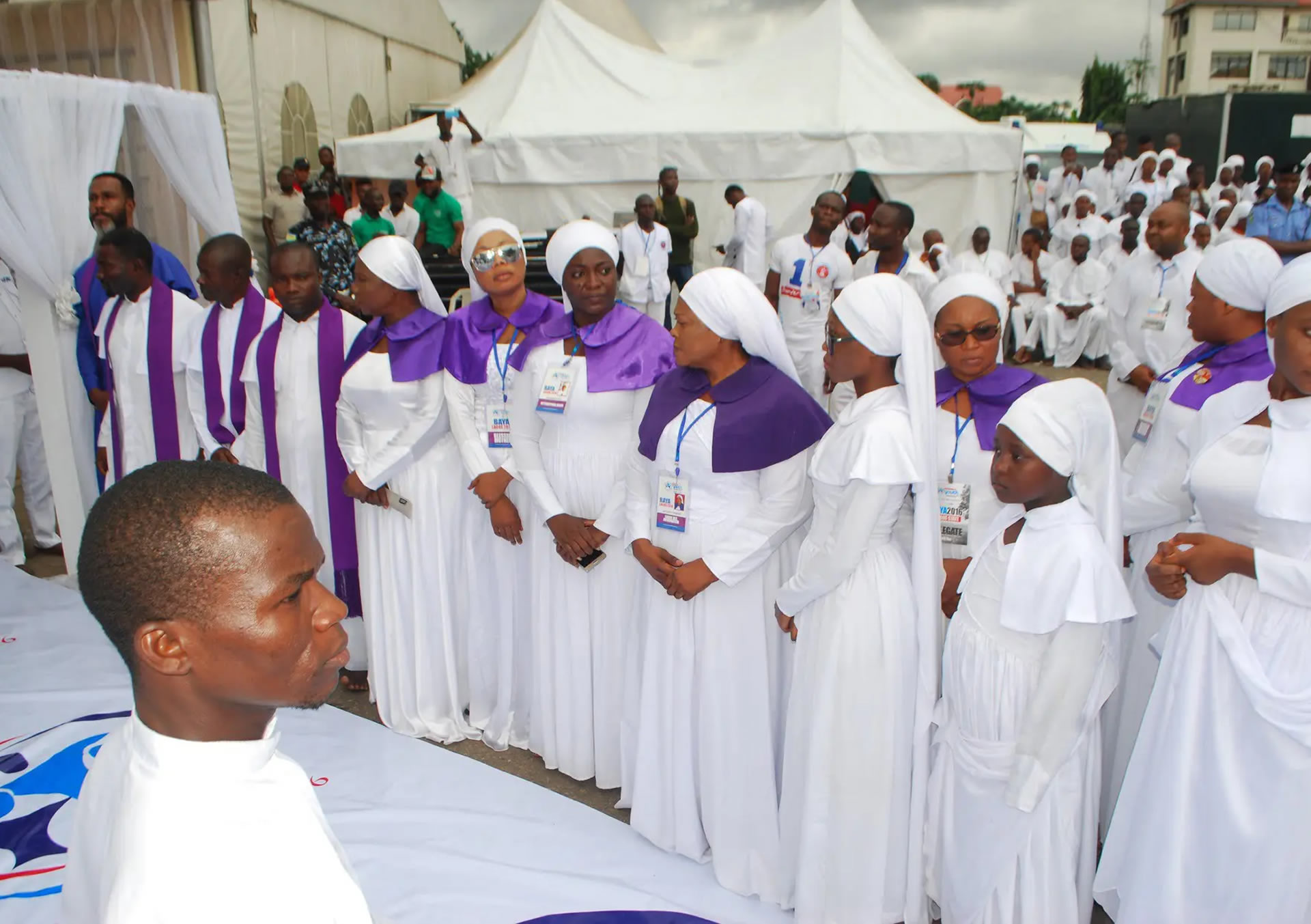
BCS dress code emphasizes simplicity and purity. Members commonly wear plain white clothing without makeup, plaits, jewelry, or wristwatches, following scriptures such as 1 Peter 3:3, 1 Timothy 2:9-10, and Exodus 32:2-4. The distinctive long white robe, called the “Soutane” or “Royal Robe,” is worn by all members and reflects the attire Christ wore during His transfiguration (Matthew 17:2; Revelation 3:4-5, 7:9, 14). The red soutane, worn by the Holy Trinity (Revelation 19:13; Isaiah 63:1; Genesis 49:11), symbolizes love and the Word of God, while the black soutane, worn only by BCS Harbingers (Revelation 11:3-6), signifies judgment. White symbolizes righteousness, purity, and peace; red stands for love and God’s Word; black represents divine judgment.
In BCS, turbans (called Sarge) are long, wide ropes in various colors tied around the waist by ordained members. Ordination is performed solely by the Holy Father, determined spiritually rather than by age or years of membership, and is based on practical love and evangelism. Turban colors signify roles: purple for bishops (1 Timothy 3:1-7), red for evangelists, apostles, and deaconesses, black for pastors, yellow for senior prophets/prophetesses, and blue, green, or brown for prophets/prophetesses. Ordained brethren sit together in a dedicated pew. Members do not wear shoes, especially in the Bethel or places of worship (Exodus 3:5; Acts 7:33), and worship takes place in Bethels, which are open 24/7. Worship centers on three keys—prayers, songs, and gospels—alongside the practice of bowing the head three times to honor the Holy Trinity (Matthew 2:11; Revelation 7:11). Prayers always start and end with thanksgiving and glorification of God, avoiding requests for material things, since God already knows what is best for His children (Matthew 6:25-26).
Fasting is a central spiritual practice, used for purification and deeper communion with God. Members often fast from 6:00 a.m. to 6:00 p.m., especially on Thursdays, the day Christ was crucified, with longer 72-hour dry fasts observed before Pentecost. During the Pentecostal period, daily fasting prepares members to receive divine blessings, though all practices are guided solely by the Holy Spirit and never imposed. Music in BCS is unique and Holy Spirit-inspired, with power to heal and bring joy. Songs are classified into three types—congregational spiritual songs, choir-rendered special songs, and hymns from the BCS hymn book—each carrying spiritual strength and divine inspiration, unlike any music found outside the fold.
Gospels and Laws of the Brotherhood
In the Brotherhood of the Cross and Star (BCS), the Word of God is the ultimate spiritual weapon, coming directly from the Author of all wisdom, with “love one another” as its foundation. These gospels, delivered by the Sole Spiritual Head of the Universe, are rooted in the Holy Bible and provide truth, comfort, strength, faith, hope, and revelation. Members live by divine laws, avoiding strikes, protests, litigation, revenge, swearing, or cursing, while embodying forgiveness, mercy, honesty, and kindness. They uphold veganism, abstaining from meat, fish, dairy, alcohol, and artificial drinks, believing fruits to be the pure food ordained by God. Medicine is not used; instead, healing comes through faith, prayer, fasting, spiritual songs, and the spoken Word.
Feast and Worship Practices
The Feast, central to BCS worship, is a vegan meal symbolizing the body and blood of Christ, as demonstrated in Luke 22:19-20. It consists of fruits, vegetables, rice, and water, and may be a fruit feast, full feast, or house feast. Worship centers around Bethels, which remain open 24/7, with prayers, songs, and gospels forming the core. Members bow three times before and after prayers and express gratitude to God in all things, avoiding requests for material needs. Fasting, especially on Thursdays, and during Pentecostal periods, serves as a spiritual purification.
Pentecostal Seasons and Daily Activities
BCS observes three Pentecostal seasons: December (birth of Christ and Leader O.O. Obu), April (passion, crucifixion, resurrection, and return promise of Christ), and August (Christ’s baptism). During these periods, daily services at 10 a.m. and 7 p.m. include blessings and teachings from the Holy Father. Weekly fellowships—men, women, children, and other groups—follow after Pentecost. Daily routines include 5 a.m. prayers, ministry work, evening services, Bible lectures, watch-and-pray vigils, and children’s Sabbath fellowships. All practices are directed by the Holy Spirit, with the aim of uniting the world in love and righteousness.